First published in JAMA Oncology, 2026
The screenings that won’t happen
New federal Medicaid restrictions could mean about 484,000 missed cancer screenings and 63 excess deaths within two years.
Updated estimate. These projections are updated continuously as new information and data become available. Last updated 12 October 2026.
What changed
- Coverage losses from 6-month renewals are counted only for Medicaid expansion adults, the group the law applies them to.
- Each state’s share of expansion adults comes from CMS new adult group enrollment (November 2024 to February 2025).
- Screening rates come from BRFSS 2022 and 2024 for adults ages 19 to 64, counting both Medicaid and state-named Medicaid plans as Medicaid coverage.
These figures revise the estimates in our JAMA Oncology research letter (2026), which reported 1.15 million missed screenings and 155 excess deaths.
Summary
Modeling coverage losses from work requirements and 6-month renewals among Medicaid expansion adults, our base scenario projects that 3.2 million people lose coverage at some point in 2027–2028. The breast, colorectal and lung screenings they miss would leave 952 cancers undetected and 134 more diagnosed at an advanced stage.
In the base scenario (12% work-requirement exit, 35% renewal churn uplift), the 484,197 projected missed screenings are 281,133 colorectal, 181,872 breast and 21,193 lung screenings, and the 63 excess cancer deaths are 20 from colorectal, 31 from breast and 11 from lung cancer. Each figure is a separate model median, so the parts may not add exactly to the total.
See the projections on Coverage Watch by scenario, by cancer type and on the state map
About 484,000 missed screenings are projected to result in 63 excess cancer deaths
484,197 missed screenings
63 excess cancer deaths
- Colorectal20
- Breast31
- Lung11
Projected missed breast, colorectal and lung cancer screenings and resulting excess deaths among Medicaid expansion adults who lose coverage at some point under work requirements and 6-month renewals, 2027–2028, base scenario (12% work-requirement exit, 35% renewal churn uplift). Bars start at zero; the deaths by cancer type have their own scale. Each figure is a separate model median, so the parts may not add exactly to the total. Source: Cancer Policy Lab model, updated October 2026; first published as Shubeck SP, Diaz A. JAMA Oncol 2026;12(3):319–321. doi:10.1001/jamaoncol.2025.5774.
Read the study
Shubeck SP, Diaz A. Projected Cancer Screening and Outcomes Under the 2025 Federal Medicaid Eligibility Restrictions. JAMA Oncol. 2026;12(3):319–321. doi:10.1001/jamaoncol.2025.5774
Data and how to cite
The values plotted above: missed screenings and excess deaths, updated October 2026, with the published values.
How to cite: Cancer Policy Lab model, updated October 2026; first published as Shubeck SP, Diaz A. JAMA Oncology 2026. doi:10.1001/jamaoncol.2025.5774
Press and media
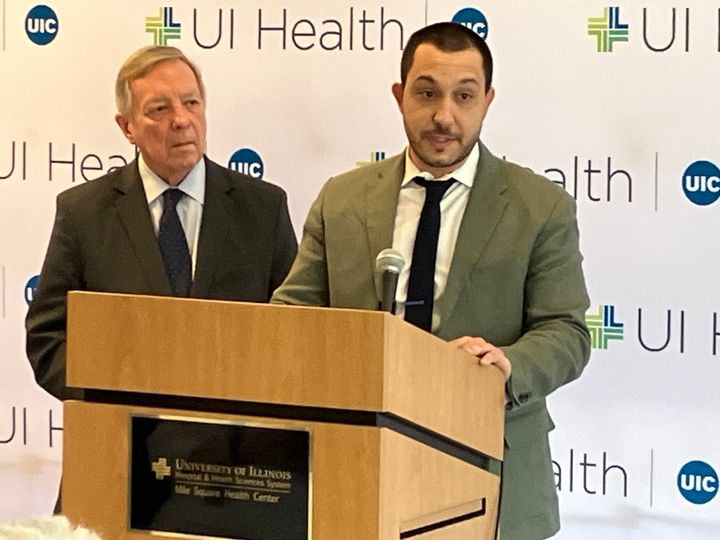
Senator Durbin held a press conference on the study at UI Health’s Mile Square Health Center in Chicago.
“Cancer screening is not luxury care. It is one of the most evidence-based and cost-effective tools in medicine.”
Adrian Diaz, MD, MPH, at the press conference